





2026-07-06
New application directions for adhesives
I. New Applications of Adhesives

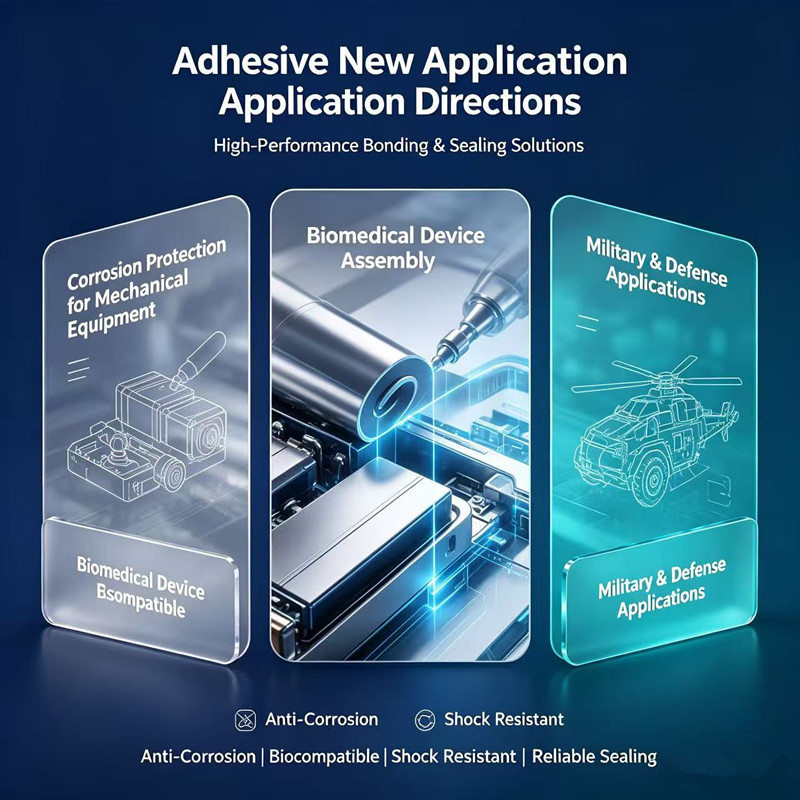
1. Corrosion Protection for Mechanical Equipment
Currently, steam pipes on ships often utilize aluminum silicate insulation combined with asbestos for thermal insulation. However, leakage or condensation resulting from temperature fluctuations can cause moisture to accumulate on the outer surface of the underlying steam pipe; furthermore, prolonged exposure to high temperatures and soluble salts leads to severe corrosion of the pipe's exterior. To address this, a sodium silicate-based adhesive can be applied as a coating over the aluminum silicate layer to form an enamel-like protective coating. This coating features a coefficient of thermal expansion similar to that of the pipe material, resulting in low thermal stress and resistance to cracking. In mechanical assembly, components are frequently secured using bolts.
Components fastened with bolts are susceptible to crevice corrosion when exposed to the atmosphere for extended periods. Additionally, intense vibration during machinery operation can cause bolts to loosen. To resolve these issues, connecting components can be bonded with an inorganic adhesive prior to bolting. This approach provides both structural reinforcement and effective corrosion protection.
2. Biomedical Applications
Hydroxyapatite (Ca10(PO4)6(OH)2, or HA) bioceramic material has a composition similar to the inorganic component of human bone and exhibits excellent biocompatibility; it can form a strong chemical bond with bone, making it an ideal material for hard-tissue replacement. However, currently produced HA implants generally suffer from high elastic moduli, low strength, and suboptimal bioactivity. By using a phosphate glass adhesive to bond HA raw powder particles together at temperatures below those required for traditional sintering, the elastic modulus can be reduced.
3. Applications in the Military Sector

3.1 Tank Maintenance
Cracking in tank engine casings is a common defect. Cracks often appear in various parts of the engine casing due to internal metallurgical flaws, stress concentrations, fatigue, or significant external forces. Addressing these issues via welding presents drawbacks such as material embrittlement, deformation, and reduced strength, alongside the consumption of electrical energy and equipment wear. In contrast, using specialized bonding technology to repair such cracks offers a solution that is fast, effective, and cost-efficient.

3.2 Applications in Military Aircraft (e.g., Light Bombers)
These aircraft primarily operate at subsonic or transonic speeds. Their fuselage and wing skins utilize aluminum alloy sheets less than 1.5 mm thick—sometimes as thin as 0.4–0.8 mm—reinforced underneath by corrugated profiles. Riveting such thin skins is difficult; however, adhesive bonding structures not only overcome issues like deformation and the loss of structural integrity caused by rivet countersinking, but also reduce tooling requirements and shorten assembly cycles. Furthermore, bonding enhances the structure's corrosion resistance, fatigue life, and damage tolerance. Adhesives are essential for sealing integral wing or fuselage fuel tanks in modern high-performance military aircraft. High-performance adhesives are also required for bonding and sealing the interface between the acrylic cockpit canopy and the polyester retention straps in fighter aircraft.
3.3 Preparation of Camouflage Materials
For ground-based army weapons, the primary threat comes from 8–14 μm infrared thermal imagers. The main approach to achieving infrared stealth is the development of infrared camouflage coatings with varying emissivity; by utilizing these differing emissivity levels to effectively segment the target's infrared image, the target can be made to blend into the background. Regarding the research into infrared stealth coatings, the use of highly transparent adhesives is one technical strategy; this involves utilizing resins that lack absorption groups within the 8–14 μm atmospheric infrared window, thereby imparting low-emissivity characteristics to the adhesive itself in that spectral range. Radar-absorbing coatings—which absorb electromagnetic waves to reduce a target's radar signature and make it difficult to detect or identify—represent a key method for achieving radar stealth in weapon systems. These coatings consist of an absorbent and an adhesive, with the adhesive determining the coating's physical-mechanical properties and application characteristics.