





2026-08-17
Key Application Areas of Construction Adhesives
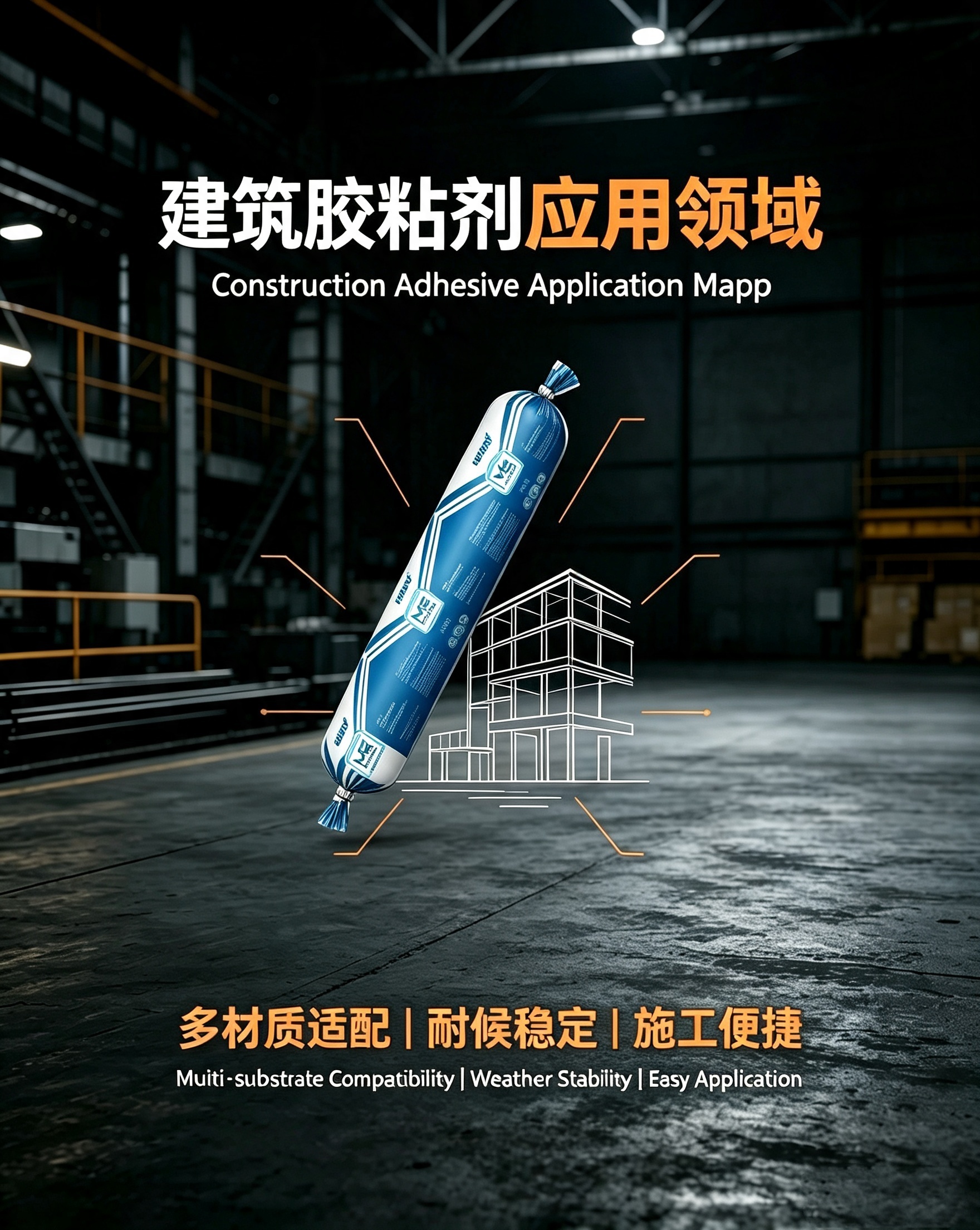
Construction adhesives are utilized across every stage of the construction process and with virtually every type of material. Their primary applications can be categorized as follows:

1.General construction and structural bonding:This includes the bonding of various precast concrete components—such as roof systems, column extensions, foundation pile extensions, and girder joints—as well as bonding reinforcement bars for partition walls in seismic-resistant frames, installing insulation materials for interior and exterior walls, bonding during pipeline installation, and joining metal components.

2.Interior and exterior decoration and renovation:Applications in this sector have expanded rapidly in recent years. Examples include bonding exterior wall tiles, installing glass curtain walls, mounting interior suspended ceilings, hanging wallpaper and wall fabrics, flooring installation, laying floor tiles, and waterproofing/sealing bathrooms. Construction adhesives are widely used in renovation projects.

3.Sealing applications:These cover doors and windows, large-panel wall systems, expansion joints, construction seams, and specialized structures. As the construction industry modernizes, the use of these types of adhesives is expected to grow significantly.
4. Application in building maintenance, renovation, and structural reinforcement. Applications in this area have expanded rapidly in recent years—particularly in renovation and reinforcement projects—where the use of structural adhesives has become widespread. These adhesives have solved complex problems that traditional methods could not address and have driven the field toward higher technical standards.

5. Reinforcement and maintenance of various transportation facilities and hydraulic engineering projects. In recent years, advancements in construction adhesives—specifically new technologies involving structural adhesives (such as carbon fiber systems)—have led to their extensive use in this sector. Applications include the reinforcement and maintenance of highway bridges, tunnels, and road surfaces; emergency repairs for airport runways; reinforcement of reinforced-concrete railway bridges; dam leak sealing and reinforcement in hydraulic projects; and the reinforcement and maintenance of specialized transportation infrastructure.
6. Widely used in the production of composite building materials: Lightweight, high-strength, and multifunctional properties define the development trajectory of composite building materials. Among the diverse range of such materials, construction adhesives serve as indispensable bonding agents during production. Applications include the manufacture of wooden housing components, modular housing units, bonded arched roof trusses, high-strength lightweight precast elements, resin composite panels, plasterboards, decorative panels, synthetic granite, various engineered wood products, composite door and window components, artificial marble, and novel building materials, as well as the production of building products from recycled polymer materials; in all these cases, construction adhesives are utilized to achieve high-performance, cost-effective products. Their importance continues to grow alongside the development of new types of chemical building materials.

7. Mixed with cement to produce various types of high-performance concrete: This application provides essential high-performance construction materials, solving numerous challenges—such as the need for high strength and rapid curing—that traditional materials cannot meet.

8. Construction adhesives are also utilized in areas such as road markings, dam waterproofing, emergency repairs for military engineering projects, and leak sealing. Consequently, construction adhesives have an extremely wide range of applications.